The short answer
Dental patient reactivation is the process of helping an eligible existing patient return for an appropriate next visit after a lapse or missed step. It is different from persuading every old contact to buy treatment. The practice determines whether a visit is clinically due, the team confirms contact permissions and the follow-up resolves administrative friction. Research on dental reminders can inform that process, but its results depend on the population and intervention. It does not supply a universal treatment acceptance rate. Track the journey from eligible recall to confirmed scheduling, attendance and collected payment, while keeping clinical recommendations with the treating team. This review separates published findings from a proposed Crypture workflow and a practice’s own future results.
Key takeaways
- Voice and SMS are not interchangeable for every dental population.
- Preventive recall evidence does not establish implant or cosmetic treatment acceptance.
- Count attended visits and net collections separately from appointment requests.
- Evidence type
- Selected published studies and official guidance
- Prepared by
- Crypture, a product of Lumino Strategies LLC
- Clinical review
- Not represented as clinically reviewed or peer-reviewed research
- Commercial interest
- Crypture sells AI sales and follow-up services
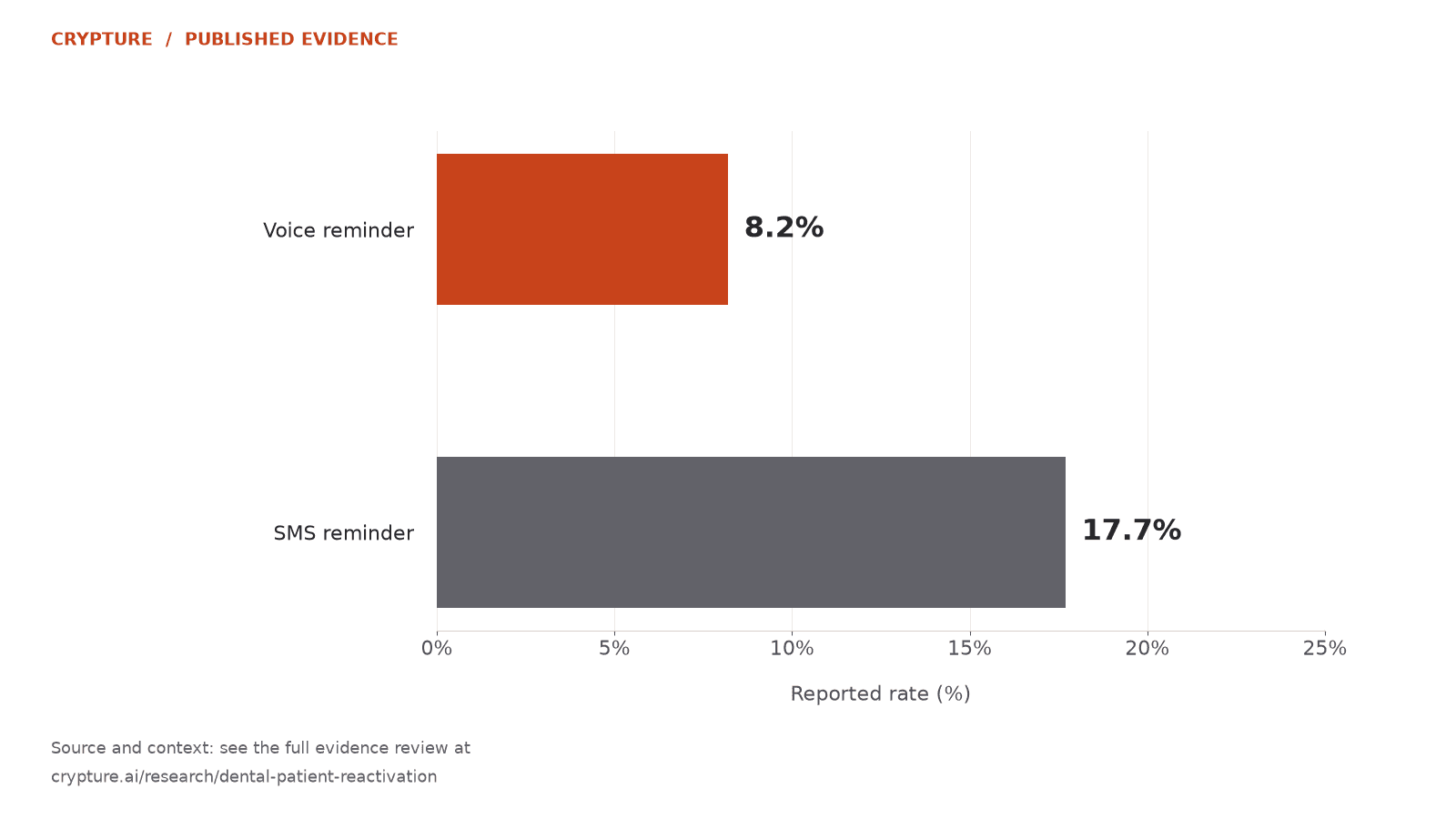
Pediatric dental reminder trial: no-show rates
| Group / scenario | Value (%) |
|---|---|
| Voice reminder | 8.2 |
| SMS reminder | 17.7 |
Does SMS always outperform a phone reminder?
No. Nelson and colleagues randomized 318 caregiver/child pairs to voice or SMS reminders in a university pediatric dental clinic. No-shows were 8.2% in the voice group and 17.7% in the SMS group. That setting and comparison matter; this finding is not a universal ranking of channels.
The practical response is to test channel fit and patient preference. A practice should not assume an automated text replaces a helpful conversation in every case. Review reachability, language, caregiver involvement and the reason the patient needs to return.
Sources: Nelson et al., 2011 ↗
What does research say about returning for preventive dental care?
A separate study of 389 dental outpatients evaluated tooth-scaling reminders accompanied by brief health education. The authors reported reminder recipients were 2.6–2.9 times more likely to revisit than those without reminders. The abstract reports 26% return in the subgroup combining high patient satisfaction with a reminder, not in every reminder recipient.
This is evidence about preventive revisiting in a particular setting. It does not mean 26% of any practice’s dormant database will return, and it does not establish a rate for accepting a high-value treatment plan. Satisfaction, prior care and the clinical reason for recall remain relevant.
Sources: Cheng et al., 2013 ↗
Which dental opportunities belong in separate cohorts?
Do not treat every chart without a future appointment as the same sales opportunity. Start with the practice’s own recall status and staff assessment. Keep patients who need clinical review outside an automated sales sequence. Then report each administrative cohort separately.
| Cohort | Useful administrative action | Completion event | Clinical boundary |
|---|---|---|---|
| Clinically due preventive recall | Explain scheduling options | Attended preventive visit | Practice sets interval |
| Missed appointment | Offer a rescheduling path | Attended rescheduled visit | Urgent concerns go to staff |
| Unscheduled consultation request | Answer visit-process questions | Attended consultation | No treatment suitability claim |
| Existing treatment-plan question | Route approved cost/process information | Staff-confirmed next step | Dentist owns recommendation |
| Incomplete payment or disputed account | Route to authorized staff | Resolved administrative issue | No automated debt-collection claim |
What should a dental reactivation sequence actually say?
Begin with a neutral explanation of the original reason for contact, using only the information permitted for the channel. Ask whether the person wants help with the next administrative step. If scheduling is supported, offer valid options; if the connection cannot confirm a booking, make clear that staff must complete the request.
A useful follow-up answers the barrier in the reply. Someone concerned about appointment length needs accurate visit information. Someone asking about insurance needs the practice’s approved verification process. Someone with pain, swelling or another clinical concern needs the appropriate staff workflow, not an AI effort to close a sale.
Stop after an opt-out, verified completion or the agreed attempt limit. Pause when a person takes over. Record what changed so another channel does not restart the same sequence.
Sources: U.S. Department of Health and Human Services, Guidance ↗
How do you measure revenue from returning dental patients?
Start with all eligible patients assigned to each workflow, including those never reached. Report confirmed appointments, attended visits and net collections in order. Collections should be linked to the agreed observation window, with cancellations, refunds and payment timing disclosed.
A return visit may be valuable without producing a new treatment sale. Do not credit a full treatment plan when only a consultation occurred. Use a comparable usual-care group where feasible, account for staff effort and channel costs, and let your finance team define the collection and contribution rules.
Reactivation attendance = attended return visits / eligible patients assigned
Incremental visits = (follow-up rate − usual-care rate) × follow-up cohort size
Where does Crypture fit in a dental recall program?
Crypture can handle the approved administrative conversation, answer practice-specific questions, follow up by supported channels and route exceptions. The practice controls which patients are eligible, what the AI can say, which scheduling actions are connected and who receives the handoff.
Before launch, demonstrate an unavailable slot, a wrong contact, a duplicate patient, an opt-out and a clinical question. Patient-data workflows require the relevant agreements and a review of each connected service. The public website and demo are not patient intake channels.
Questions and answers
Can you promise a dental reactivation percentage?
No. The cited studies involve specific populations and reminder designs. A practice needs its own measured eligible cohort and outcome window.
Should we contact every inactive patient?
No. Your practice should establish clinical appropriateness, contact permission, record accuracy and suppression rules first.
Is a booked consultation recovered treatment revenue?
No. Report the booking, attended consultation, agreed treatment and collected payment as separate events.
Sources and study context
- Assessing the effectiveness of text messages as appointment reminders in a pediatric dental setting ↗
Authors: Nelson et al. · Published: 2011
Design: Randomized controlled trial
Scope: 318 caregiver/child pairs at a university pediatric dental clinic; SMS versus voice reminders. - Effects of tooth scaling reminders for dental outpatients ↗
Authors: Cheng et al. · Published: 2013
Design: Comparative reminder intervention study
Scope: 389 dental outpatients; reminders with brief health education and preventive return visits. - Business Associates ↗
Authors: U.S. Department of Health and Human Services · Published: Guidance
Design: Official HIPAA guidance
Scope: Business-associate responsibilities and agreements; not a product certification.
How this review was prepared
Crypture reviewed the linked study records or available full texts and developed the operational interpretation separately. This is a selected evidence review, not an exhaustive systematic review. Source access varies; no patient-level data or unpublished Crypture outcomes are included.
Read the methodology, definitions and correction process. Report a factual error with the page URL and source to support@crypture.ai.
Put the evidence to work.
Start with one eligible cohort and a completed outcome. Confirm what the AI can answer, what the connected system can do and where your staff take over.
Explore Crypture for dental practices ↗Book a workflow review ↗