The short answer
Revenue recovery ROI measures whether follow-up on existing eligible demand creates enough additional contribution to cover its full incremental cost. The critical word is additional. Some people would have purchased or returned without another contact, so a dashboard that attributes every later conversion to a message can overstate value. A credible analysis compares equivalent groups, verifies completed outcomes and accounts for product or service delivery costs, discounts, refunds, staff effort and channel fees. In healthcare, a consultation booking should not be valued as a completed course of treatment. This page provides a transparent illustrative model, not a Crypture customer case study or an industry benchmark. Its assumptions are editable in the downloadable data so your finance team can replace them with measured inputs.
Key takeaways
- Attributed revenue is not the same as incremental revenue.
- Use contribution after delivery costs; do not subtract a guessed margin from gross sales and call it proof.
- Repeat customers affect retention economics, not the count of newly acquired customers.
- Evidence type
- Illustrative financial model; no measured customer outcomes
- Prepared by
- Crypture, a product of Lumino Strategies LLC
- Clinical review
- Not represented as clinically reviewed or peer-reviewed research
- Commercial interest
- Crypture sells AI sales and follow-up services
Illustrative recovery economics: the break-even threshold
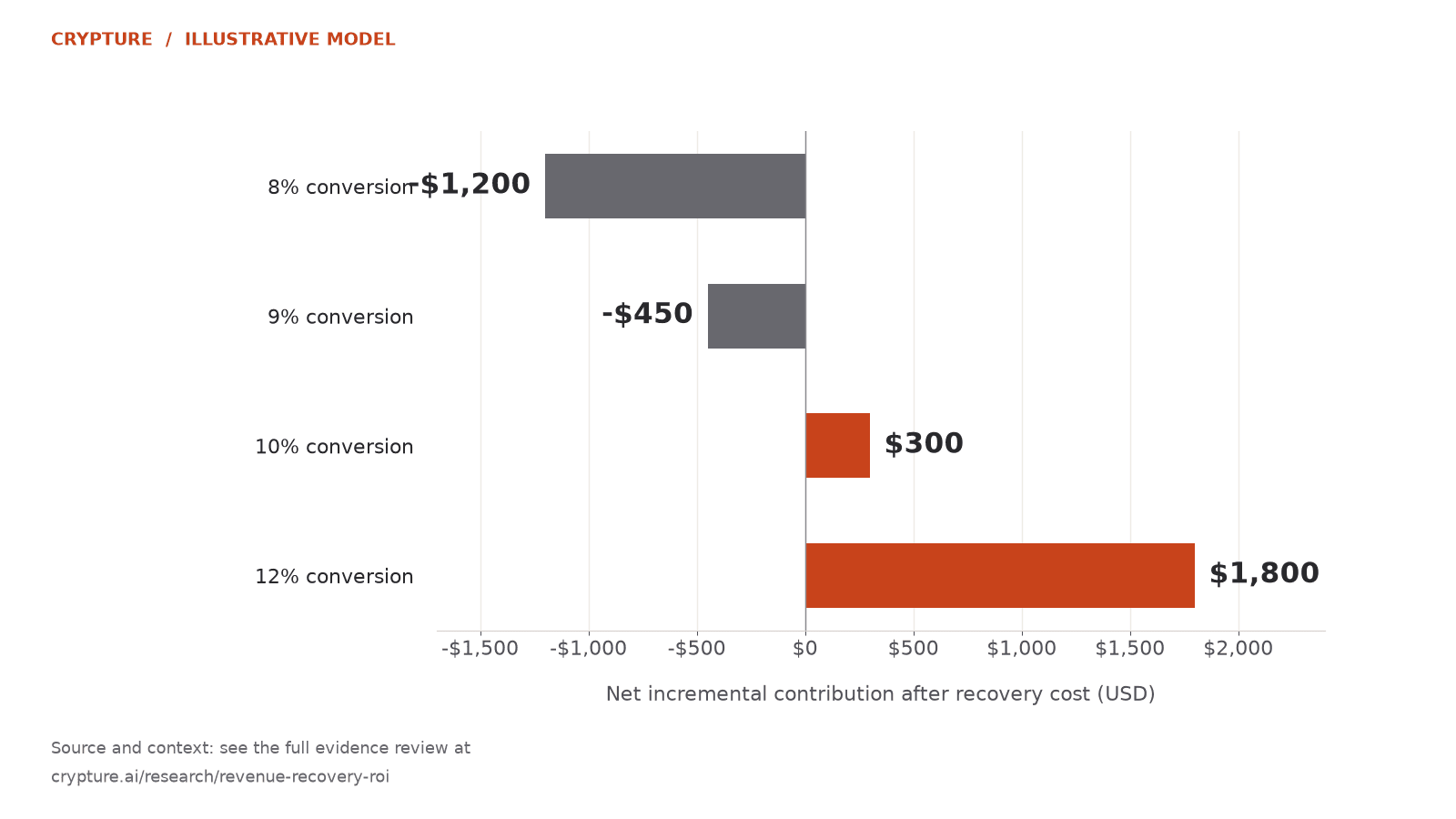
| Group / scenario | Value (USD) |
|---|---|
| 8% conversion | -1200 |
| 9% conversion | -450 |
| 10% conversion | 300 |
| 12% conversion | 1800 |
What is the difference between attribution and incrementality?
Attribution assigns credit according to a rule, such as an order after a tracked link. Incrementality asks how many outcomes would not have happened without the intervention. A purchase can be both attributed to a follow-up and likely to have occurred anyway.
A randomized holdout is often a useful commercial design when feasible and appropriate. Otherwise use a clearly described comparison and acknowledge that selection, seasonality and lead quality may explain part of the difference. A before-and-after chart alone does not isolate the effect of the AI.
How does the worked example calculate recovery ROI?
Assume 500 eligible contacts in a follow-up cohort and an equivalent comparison cohort. The comparison converts at 8%. If the follow-up cohort converts at 10%, its 50 conversions exceed the 40 expected at the comparison rate by 10. At an assumed $150 contribution per additional completed conversion, the added contribution before recovery cost is $1,500.
Subtract an assumed $1,200 recovery cost to obtain $300 net incremental contribution. Dividing $300 by $1,200 gives 25% incremental ROI. Every number here is hypothetical. No study or customer supplied these outcomes. The example describes arithmetic, not a typical result.
Incremental conversions = cohort size × (test rate − comparison rate)
Net incremental contribution = incremental conversions × contribution per conversion − recovery cost
Incremental ROI = net incremental contribution / recovery cost
At what conversion rate does the example break even?
The $1,200 cost requires eight additional conversions at $150 contribution each. Across 500 eligible contacts that is 1.6 percentage points of lift. With the assumed 8% comparison rate, break-even is 9.6%. Below that point, the modeled incremental contribution does not cover the modeled recovery cost.
Use sensitivity analysis before buying a growth story. Lower contribution per outcome, more staff review or a smaller verified lift can reverse the decision. A positive attributed-revenue total does not resolve those questions.
| Test rate | Incremental conversions | Added contribution before recovery cost | Net after $1,200 cost | ROI |
|---|---|---|---|---|
| 8% | 0 | $0 | −$1,200 | −100% |
| 9% | 5 | $750 | −$450 | −37.5% |
| 10% | 10 | $1,500 | $300 | 25% |
| 12% | 20 | $3,000 | $1,800 | 150% |
Which costs belong in the calculation?
Agree the cost definition with finance before the pilot. Include the allocated setup, service fee, usage charges, staff review and support work caused by the new workflow. Contribution per outcome should already reflect the relevant delivery costs, discounts, refunds and other variable costs. Avoid subtracting the same cost twice.
If a customer upgrades an existing order, count the incremental contribution of the upgrade rather than the entire order. For deferred or subscription revenue, define the observation window and treatment of cancellations. For constrained clinical capacity, consider whether the recovered visit displaces another visit rather than adding capacity.
How should dental and telehealth businesses value a recovered patient?
Use the verified event and an appropriate value. An attended preventive visit, completed consultation, accepted treatment plan and collected treatment payment are separate stages. A modeled lifetime value is not a collected payment and should be labeled as a forecast if used.
For retail supplements, track paid orders after the agreed return window. For GLP-1 services, commercial reporting cannot imply that a clinical decision was made to increase retention. Keep clinical appropriateness and patient choice outside the sales incentive.
Can follow-up reduce CAC?
It can reduce a defined acquisition-cost measure if it adds genuinely new customers efficiently. It does not erase the cost of originally acquiring the demand. Include the agreed acquisition and recovery expenses, then divide by newly acquired customers in the same scope and period.
Keep reorders out of the new-customer denominator. Follow-up to existing customers can improve repeat-purchase contribution even if it does not change new-customer CAC. Showing both metrics is more useful than forcing every benefit into one acquisition claim.
Scoped CAC = agreed acquisition and recovery costs / genuinely new customersWhat should a Crypture pilot report?
Crypture’s AI-led or AI-assisted sales workflow should have one named outcome, one eligible cohort and a clear system of record. Report contact attempts and helpful replies as leading indicators, then show verified purchases or attended visits, incremental contribution and the complete cost.
Review opt-outs, inaccurate answers, clinical escalations and staff workload beside the economics. A program with attractive modeled ROI but poor customer experience needs correction before scaling. Bring the model and your actual cost assumptions to the workflow review.
Questions and answers
Are the chart values Crypture results?
No. They are a disclosed hypothetical model designed to make the calculation auditable.
Can revenue recovery have a negative ROI?
Yes. If added contribution is smaller than the all-in incremental cost, the recovery program loses money on that definition.
Do repeat purchases lower new-customer CAC?
Repeat purchases improve retention economics but are not newly acquired customers. Report those measures separately.
How this review was prepared
Crypture developed this educational model from the explicitly stated hypothetical assumptions. It contains no study-derived conversion estimate, patient-level data or measured customer outcomes. The formulas and scenario data are provided so readers can check the arithmetic.
Read the methodology, definitions and correction process. Report a factual error with the page URL and source to support@crypture.ai.
Put the evidence to work.
Start with one eligible cohort and a completed outcome. Confirm what the AI can answer, what the connected system can do and where your staff take over.
Plan a measured revenue recovery pilot ↗Book a workflow review ↗