The short answer
Patient reactivation after a missed appointment is an administrative effort to help an eligible person complete a still-appropriate next visit. It should resolve the reason the visit was missed rather than repeat a generic booking prompt. Evidence for this exact problem is more relevant than statistics about reminders sent before an appointment. Outcomes can also vary across populations, so an overall average should not hide language or access differences. The evidence below concerns care attendance, not buying treatment. It supports a measured access workflow with appropriate staff oversight; it does not supply a guaranteed return rate for dental, telehealth or wellness businesses. Crypture’s proposed application is administrative follow-through within the practice’s approved scope, followed by independent verification of the attended visit.
Key takeaways
- Study the exact step: rebooking after a no-show differs from preventing one.
- Language-specific results can differ; report them instead of hiding them in an average.
- More patient interaction does not automatically mean better downstream outcomes.
- Evidence type
- Selected published studies and official guidance
- Prepared by
- Crypture, a product of Lumino Strategies LLC
- Clinical review
- Not represented as clinically reviewed or peer-reviewed research
- Commercial interest
- Crypture sells AI sales and follow-up services
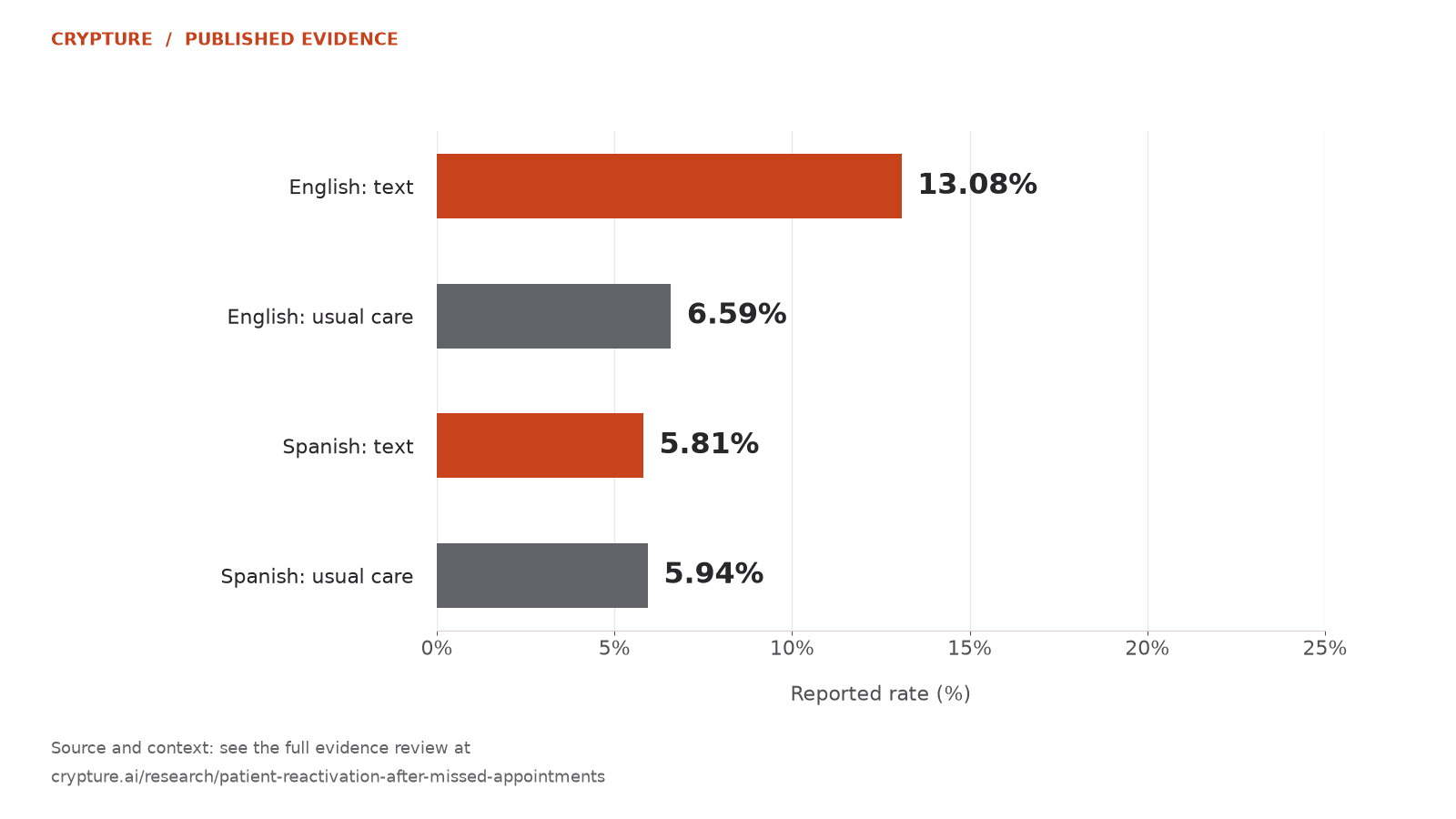
Completed well-child visits after a missed appointment
| Group / scenario | Value (%) |
|---|---|
| English: text | 13.08 |
| English: usual care | 6.59 |
| Spanish: text | 5.81 |
| Spanish: usual care | 5.94 |
How many patients returned after text follow-up?
In Debinski and colleagues’ pilot randomized trial involving 720 patients after missed well-child visits, six-week completion rates were 13.08% with texts versus 6.59% with usual care in the English-language group. The Spanish-language comparison was 5.81% versus 5.94%.
The language-group results should stay visible. This pediatric setting does not establish a return rate for adult wellness services, a dental recall list or a commercial telehealth brand. The result is a completed care visit, not a purchase. It also does not tell a practice that every language group will respond to the same workflow.
Sources: Debinski et al., 2024 ↗
Can more messages create more interaction without a better outcome?
Yes. A 2024 post-discharge randomized trial included 4,736 people across 30 practices. Acute-care revisits within 30 days were 23.9% with automated texting and 23.4% with usual care: risk ratio 1.02, 95% confidence interval 0.92–1.13. It did not demonstrate a reduction in that primary outcome.
This is a different clinical problem, not a contradiction that cancels the missed-visit trial. It shows why engagement metrics cannot replace the outcome a program intends to change. The implementation decision should follow the relevant outcome and setting, not the fact that a messaging system exists.
Sources: Bressman et al., 2024 ↗
What should happen immediately after a no-show?
First confirm the record. A delayed status update, staff reschedule or duplicate appointment should not trigger a second outreach path. Have the practice identify whether the next step is still appropriate, whether staff need to triage the case and which communication channel is permitted.
Then offer practical help. The person may need a different time, an accessible booking path, the correct location or a human explanation of the process. Keep sensitive clinical context out of a generic text. If a patient describes symptoms or urgent needs, follow the practice’s clinical and emergency routing instructions.
How can you evaluate a missed-visit recovery program fairly?
Use the missed appointment as the enrollment event and assign eligible records before outreach. Compare the new workflow with the existing administrative process using the same observation window. Necessary care and clinically required outreach should never be withheld for a sales test.
Report attempts, delivered contacts, replies, accepted reschedules and attended rescheduled visits separately. Count everyone assigned to the eligible cohort in the primary rate. Otherwise an analysis restricted to people who answered will overstate population-level recovery.
| Field | Why it matters |
|---|---|
| Eligibility date and reason | Prevents changing the denominator after replies arrive |
| Assigned workflow | Supports a reproducible comparison |
| Language and access needs where appropriate | Reveals meaningful differences without assuming cause |
| Reschedule status | Separates intent from attendance |
| Attended return visit and date | Defines actual completion |
| Opt-out, complaint or clinical handoff | Keeps experience and safety visible |
| Staff and service costs | Makes operating value assessable |
When is reactivation the wrong intervention?
If no appropriate appointments are available, repeated outreach can create frustration without improving access. If the original visit is no longer clinically appropriate, staff must decide the next step. If the record is wrong or permission is absent, fix the underlying issue before adding automation.
For capacity planning, distinguish an earlier cancellation from a recovered visit. Both may help operations, but they affect the schedule in different ways. A released slot is not additional revenue unless a subsequent completed service supports that claim.
How would Crypture support this workflow?
Your practice sets the eligible population, approved administrative responses, staff destinations and stop rules. Crypture can call or text within that scope, answer process questions and guide a supported rescheduling action. The schedule or staff confirmation determines whether a visit is actually booked.
Review a sample of ordinary conversations and failures before expansion. The goal is useful access and verified completion, not maximizing attempts. A person’s request for help, an opt-out or staff takeover should change the workflow immediately.
Questions and answers
Can we use the English-language result for all patients?
No. The trial reported materially different language-group results. Preserve those differences and evaluate local access barriers rather than assuming a universal effect.
Does an increased reply rate prove the program works?
No. A reply is an intermediate event. Evaluate the completed visit and the operating cost alongside experience and handoffs.
What counts as a recovered visit?
Define it in advance, usually an eligible missed-visit patient completing the appropriate rescheduled visit within a stated window. A reschedule request alone is not attendance.
Sources and study context
- A Pilot Randomized Controlled Trial of Text Messages to Improve Well-Child Visit Attendance After No-Show ↗
Authors: Debinski et al. · Published: 2024
Design: Pilot randomized controlled trial
Scope: Children with a missed well-child visit; text follow-up versus usual care and attendance within six weeks. - Automated Text Message–Based Program and Use of Acute Health Care Resources After Hospital Discharge ↗
Authors: Bressman et al. · Published: 2024
Design: Randomized clinical trial
Scope: 4,736 participants across 30 practices; post-discharge texting and acute-care use, not sales.
How this review was prepared
Crypture reviewed the linked study records or available full texts and developed the operational interpretation separately. This is a selected evidence review, not an exhaustive systematic review. Source access varies; no patient-level data or unpublished Crypture outcomes are included.
Read the methodology, definitions and correction process. Report a factual error with the page URL and source to support@crypture.ai.
Put the evidence to work.
Start with one eligible cohort and a completed outcome. Confirm what the AI can answer, what the connected system can do and where your staff take over.
Explore administrative follow-up for medical practices ↗Book a workflow review ↗