The short answer
Patient follow-up can remove practical barriers between an existing care request and an attended appointment. Published reminder studies support testing that workflow, but they do not establish a universal patient return rate or prove that an AI sales team increases revenue. A reminder for an already scheduled visit, an invitation after a missed appointment and an offer to purchase a product are different interventions. Evaluate them separately. Start with a defined eligible population, retain a comparison group where appropriate and verify attendance or a completed purchase in the relevant system. This evidence review distinguishes observed study outcomes from Crypture’s recommended measurement approach; none of the published results below are Crypture customer results.
Key takeaways
- Reminder evidence supports a workflow hypothesis, not a guaranteed recovery percentage.
- Attendance, patient return, paid treatment and product purchase need separate denominators.
- Measure incremental outcomes and the full operating cost before expanding a sequence.
- Evidence type
- Selected published studies and official guidance
- Prepared by
- Crypture, a product of Lumino Strategies LLC
- Clinical review
- Not represented as clinically reviewed or peer-reviewed research
- Commercial interest
- Crypture sells AI sales and follow-up services
2026 report: targeted calls added to text reminders
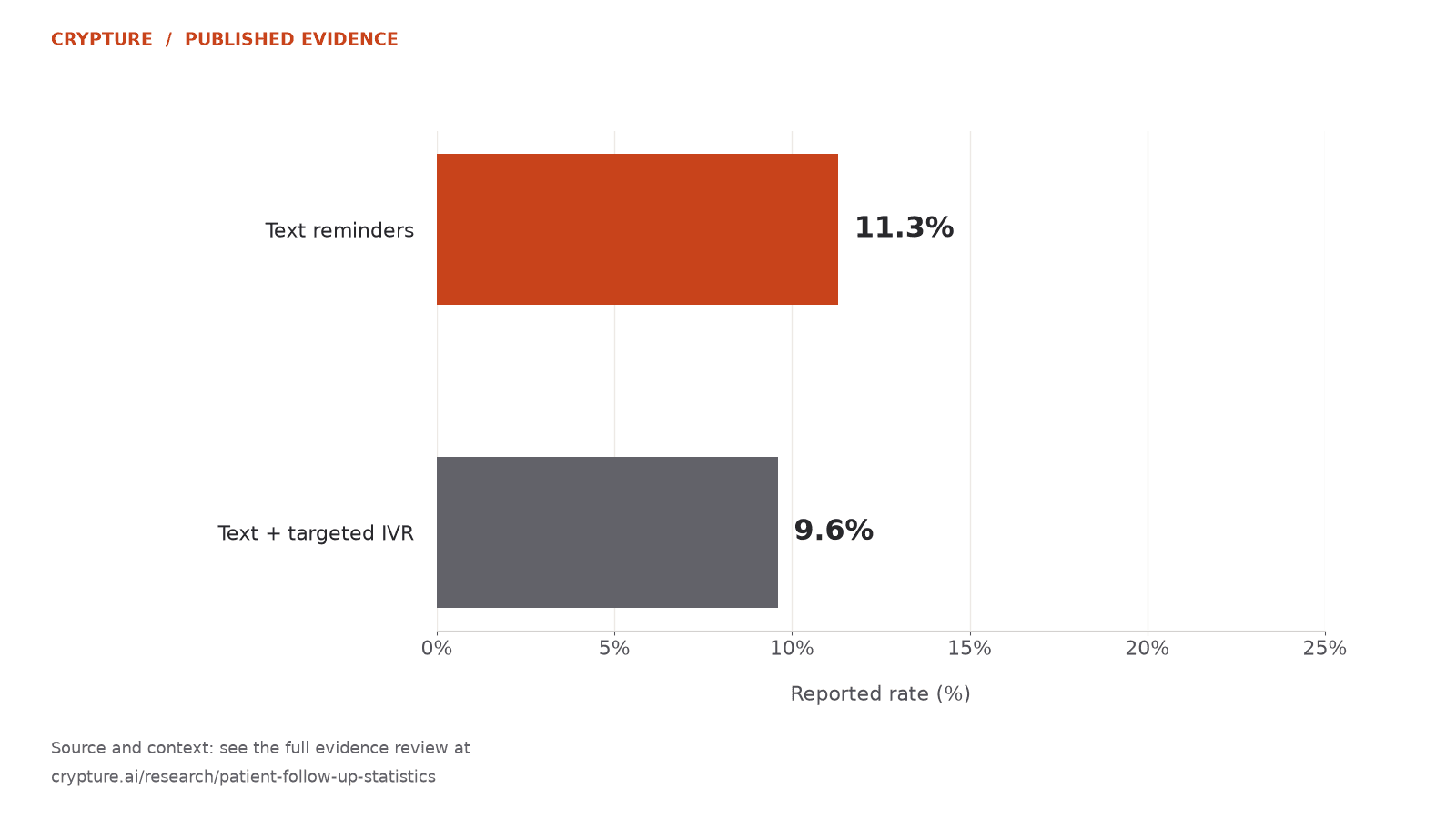
| Group / scenario | Value (%) |
|---|---|
| Text reminders | 11.3 |
| Text + targeted IVR | 9.6 |
What does a 2026 voice-plus-text report add?
Penn’s PAIR Center summarizes a randomized trial published in NEJM Catalyst in May 2026. It involved 59,994 high-risk patients during 2024. Adding targeted interactive voice response calls to existing text reminders lowered no-shows from 11.3% to 9.6%; appointment completion rose from 75.9% to 77.8%.
The comparison is an extra IVR reminder for a selected high-risk population. It is not a trial of conversational AI, cold-lead sales or Crypture. A targeted additional touch may help without justifying extra calls to every patient. We reviewed the research institution’s summary, not patient-level data.
What does the strongest reminder evidence say?
The 2013 Cochrane review included eight randomized trials and 6,615 participants. Its pooled comparison of text reminders with no reminder reported a risk ratio of 1.14, with a 95% confidence interval of 1.03–1.26. The review rated this comparison as moderate-quality evidence.
The review also reported summary attendance rates of 67.8% without reminders, 78.6% with texts and 80.3% with phone reminders. Do not subtract those summary rates and call the difference a guaranteed treatment effect. They summarize heterogeneous studies; the pooled risk ratio is a different statistical calculation. The review predates modern conversational AI and does not test Crypture.
Sources: Gurol-Urganci et al., 2013 ↗
Which follow-up outcome are you trying to improve?
A useful recovery program names the missing step before selecting a channel. Someone who forgot an appointment needs different help from someone who asked about a product but never ordered. Combining these populations can make the dashboard look better while hiding the actual result.
| Workflow | Outcome | Denominator | Do not substitute |
|---|---|---|---|
| Scheduled-visit reminder | Attended visit | Eligible scheduled visits | Messages delivered |
| Missed-visit follow-up | Completed rescheduled visit | Eligible missed visits | New appointment requests |
| Dental recall | Attended clinically due visit | Eligible patients due for recall | Entire patient database |
| Program inquiry | Verified enrollment or administrative handoff | Eligible program inquiries | Clinical eligibility |
| Product reorder | Paid, retained order | Eligible reorder contacts | Checkout links sent |
Why might a follow-up change the outcome?
The first operational question is what prevented the next step. A person may need a clear appointment time, help rescheduling, a link that works on their phone or an explanation of purchase terms. A repeated sales message does not resolve every barrier. Classify the reason for delay and give the workflow an appropriate response.
Record unsuccessful outcomes too. An unavailable appointment, a disconnected number or an unsupported language can explain why a message failed without implying the person was uninterested. Where access is the issue, staff capacity and scheduling design may matter more than adding another touch.
How should a practice test follow-up?
Choose one workflow and define eligibility before outreach. Exclude suppressed contacts, duplicates, completed outcomes and requests that need clinical review. Assign the comparison before looking at replies. When feasible, compare usual care with the added administrative follow-up rather than withholding necessary care.
Use the same outcome window and system of record for both groups. Report group size, completed outcomes, cancellations, opt-outs, incorrect answers and staff interventions. If the groups differ in access, lead age or service type, disclose that difference instead of presenting the comparison as randomized evidence.
Attendance rate = attended eligible visits / all eligible scheduled visits
Absolute lift = intervention rate − comparison rate
How does Crypture apply this to revenue recovery?
Crypture’s AI sales team supports approved questions, voice and text follow-up, supported scheduling or purchase actions and staff handoffs. Before launch, your team defines the offer, eligible contacts, contact windows, attempt limit and evidence that confirms the next step. CRM records support that process.
For healthcare, administrative and approved product information stay separate from diagnosis, prescribing and treatment decisions. A visit request is not a confirmed appointment; an attended consultation is not collected treatment revenue. These distinctions should appear in the reporting configuration, not only in the proposal.
What should you do with these statistics?
Use published studies to justify a focused test, not to fill a sales forecast with someone else’s results. Keep the original study context attached whenever you reuse a number. Choose an operational bottleneck you can actually change and a completed outcome you can verify. Expand only when the added contribution, service quality and workload support it.
Questions and answers
What percentage of patients come back after follow-up?
There is no defensible single percentage across specialties, populations and follow-up types. Use a study that matches your question, then measure your own eligible cohort.
Do these studies prove AI increases revenue?
No. The cited reminder review studies appointment attendance. It does not test Crypture, modern AI selling or collected revenue.
Is a text reply a recovered patient?
No. A reply indicates engagement. Define recovery as the completed event you intended to change, such as an attended return visit, and report replies separately.
Sources and study context
- Automated calls added to SMS reminders reduce missed appointments among high-risk patients ↗
Authors: Kavanaugh et al.; Penn PAIR Center summary · Published: 2026
Design: Research institution summary of a randomized trial published in NEJM Catalyst
Scope: 59,994 high-risk patients; added interactive voice response calls versus existing SMS reminders. Trial conducted in 2024; report published May 20, 2026. - Mobile phone messaging reminders for attendance at healthcare appointments ↗
Authors: Gurol-Urganci et al. · Published: 2013
Design: Cochrane systematic review of eight randomized trials
Scope: 6,615 participants; appointment attendance, not purchases or AI sales.
How this review was prepared
Crypture reviewed the linked study records or available full texts and developed the operational interpretation separately. This is a selected evidence review, not an exhaustive systematic review. Source access varies; no patient-level data or unpublished Crypture outcomes are included.
Read the methodology, definitions and correction process. Report a factual error with the page URL and source to support@crypture.ai.
Put the evidence to work.
Start with one eligible cohort and a completed outcome. Confirm what the AI can answer, what the connected system can do and where your staff take over.
Explore the revenue recovery workflow ↗Book a workflow review ↗