The short answer
Telehealth patient retention means maintaining an appropriate relationship with a service over a defined period. That might involve attending a planned follow-up, completing an administrative enrollment step or choosing to reorder a nonprescription product. These are different outcomes and should not be collapsed into one retention percentage. Telehealth research can reveal access and attendance patterns, but it does not prove an AI follow-up system causes repeat purchases or long-term clinical adherence. A credible program defines the eligible cohort, addresses the barrier to the next step and verifies the outcome in its source system. For GLP-1 and other prescription programs, clinical eligibility, prescribing and treatment changes belong to qualified clinicians. Sales automation should support approved information and administrative work around that boundary.
Key takeaways
- Appointment modality evidence is observational, not proof that AI follow-up causes improvement.
- Track care attendance, program enrollment and product reorder as separate journeys.
- Keep clinical decisions out of sales automation and review approved health-product claims.
- Evidence type
- Selected published studies and official guidance
- Prepared by
- Crypture, a product of Lumino Strategies LLC
- Clinical review
- Not represented as clinically reviewed or peer-reviewed research
- Commercial interest
- Crypture sells AI sales and follow-up services
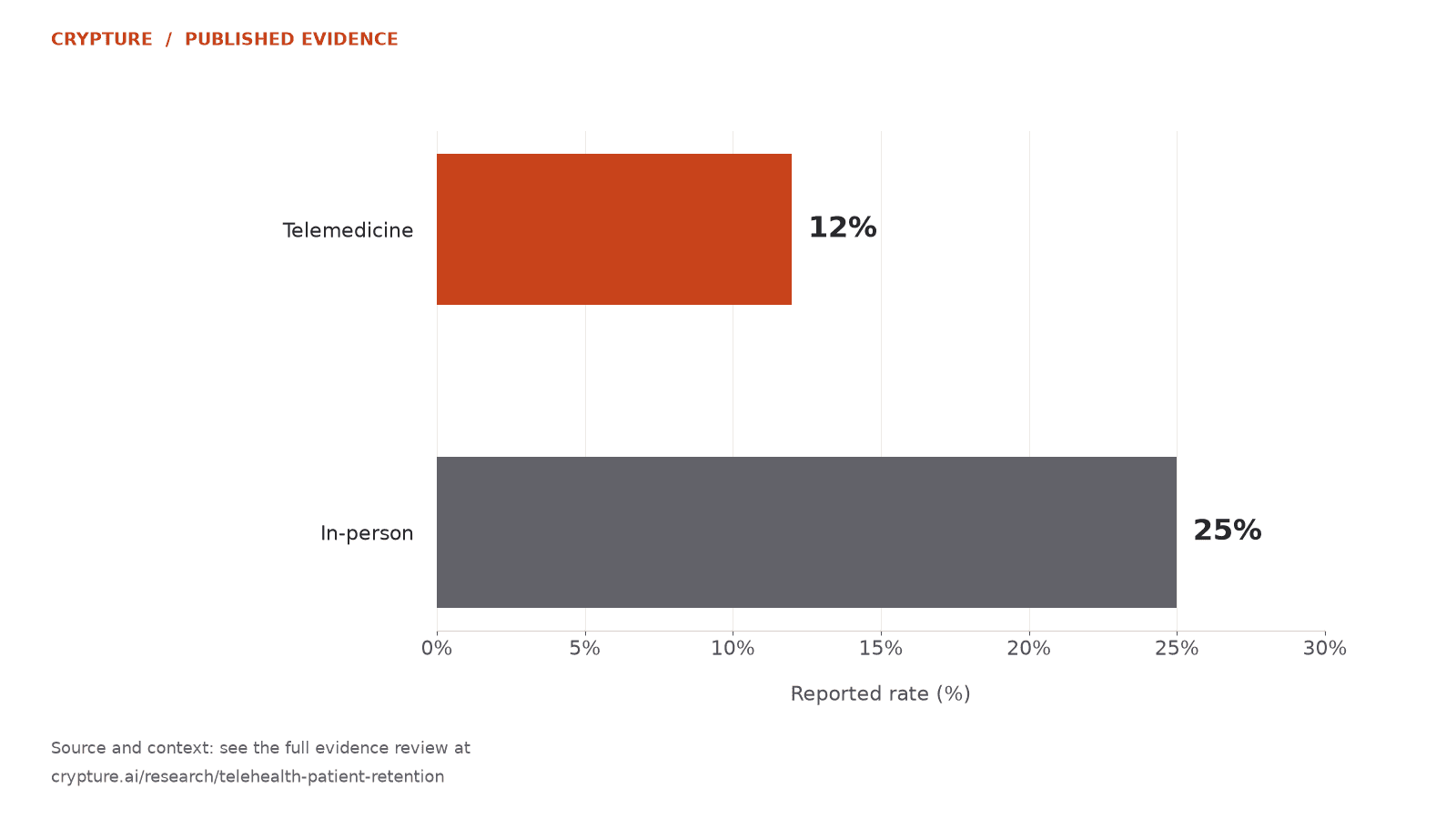
No-shows by appointment modality in a safety-net cohort
| Group / scenario | Value (%) |
|---|---|
| Telemedicine | 12 |
| In-person | 25 |
What does the telehealth attendance evidence show?
Ojinnaka and colleagues analyzed 474,212 appointments in a safety-net health system. Reported no-shows were 12% for telemedicine and 25% for in-person appointments. The adjusted association favored telemedicine, with an odds ratio of 0.40 and 95% confidence interval of 0.40–0.41.
This retrospective study compared appointment modalities. It did not randomize an AI follow-up service, establish supplement repurchase rates or measure Crypture. Its access context may differ substantially from a cash-pay wellness or GLP-1 program. Use the result to ask better questions about access, not to forecast a recovery rate.
Sources: Ojinnaka et al., 2024 ↗
Which telehealth journeys need different follow-up?
The same brand may operate a clinical service and a retail catalog. The intended outcome, allowed information and responsible staff differ. Store these as separate workflows so a sales objection is not mistaken for a clinical concern.
| Journey | Appropriate administrative support | Verified outcome | Never infer |
|---|---|---|---|
| Missed virtual visit | Help with access or rescheduling | Completed visit | Treatment was continued |
| Program inquiry | Explain approved process and fees | Confirmed enrollment step | Prescription eligibility |
| Supplement question | Provide approved product and purchase facts | Paid retained order | Individual clinical suitability |
| Reorder inquiry | Clarify one-time or subscription terms | Verified repeat order | Patient needs a higher dose |
| Cancellation or concern | Explain approved policy and route support | Resolved request or staff takeover | Every cancellation should be reversed |
Why might a telehealth patient fail to return?
Investigate the step where the journey stopped. A patient may have an expired video link, a time-zone misunderstanding, an unresolved billing question or no suitable appointment. A product buyer may be unsure whether a reorder begins a subscription. These problems call for different answers and different staff ownership.
Ask the person what they need rather than inferring a health condition from shopping behavior. Keep follow-ups specific to the original permitted request. If a reply raises side effects, medication use or a treatment question, stop the commercial path and use the approved clinical handoff.
How should supplement and GLP-1 brands handle sales claims?
FTC guidance explains that objective health-product claims need adequate support and must not mislead. An AI message should not invent a benefit, imply an individual outcome or use appointment evidence as proof a product works. Brand-approved copy still needs an appropriate substantiation process.
For a supplement inquiry, helpful sales support can explain the current label, pack size, price, delivery and cancellation terms within approved scope. For prescription programs, staff and clinicians must own eligibility, prescribing, dosage and clinical advice. A reorder reminder is not authorization to change treatment.
Sources: Federal Trade Commission staff, 2022 ↗ · U.S. Department of Health and Human Services, Guidance ↗
How do you calculate retention without inflating it?
Choose a cohort start event such as first completed purchase or first attended visit. Define the later event and observation window before examining results. Use only members who have had enough time to reach that window, and distinguish a repeat order from a renewal charge that was refunded.
Break results out by product or program and acquisition source where group sizes allow meaningful interpretation. Report counts as well as percentages. A rate based on a handful of early customers is unstable; a combined rate can hide substantial differences in access, price and eligibility.
Repeat-purchase rate = customers with a qualifying later order / eligible first-purchase cohort
Return-visit rate = cohort members with a qualifying later attended visit / eligible initial-visit cohort
How does Crypture support these journeys?
Crypture’s AI sales team can answer approved questions, handle purchase hesitation, call and text eligible leads on the agreed schedule and guide supported purchase or appointment actions. AI-led and AI-assisted modes let the brand decide where people stay in control.
The launch review should specify exact product knowledge, stop rules, data access, supported systems and clinical handoffs. Begin with one administrative or product-sales journey and compare verified completion and net contribution with the existing process. The chart above is context for that work, not a performance claim.
Questions and answers
Does the chart prove telehealth follow-up improves retention?
No. It compares observed appointment modalities in one health system, not a follow-up intervention or long-term retention.
Can AI follow up on GLP-1 program inquiries?
It can support approved program and administrative questions within the agreed deployment. Clinical eligibility, prescriptions and treatment decisions remain with qualified professionals.
Should supplement reorders count as patient return visits?
No. Report a retail repeat purchase separately from an attended clinical visit.
Sources and study context
- Telemedicine Reduces Missed Appointments but Disparities Persist ↗
Authors: Ojinnaka et al. · Published: 2024
Design: Retrospective observational cohort
Scope: 474,212 appointments in a safety-net system, March 2020–December 2022; modality and no-shows. - Health Products Compliance Guidance ↗
Authors: Federal Trade Commission staff · Published: 2022
Design: Official advertising substantiation guidance
Scope: Truthful health-product claims and adequate scientific support; not a conversion study. - Business Associates ↗
Authors: U.S. Department of Health and Human Services · Published: Guidance
Design: Official HIPAA guidance
Scope: Business-associate responsibilities and agreements; not a product certification.
How this review was prepared
Crypture reviewed the linked study records or available full texts and developed the operational interpretation separately. This is a selected evidence review, not an exhaustive systematic review. Source access varies; no patient-level data or unpublished Crypture outcomes are included.
Read the methodology, definitions and correction process. Report a factual error with the page URL and source to support@crypture.ai.
Put the evidence to work.
Start with one eligible cohort and a completed outcome. Confirm what the AI can answer, what the connected system can do and where your staff take over.
Explore Crypture for telehealth brands ↗Book a workflow review ↗